What is Acromegaly?:
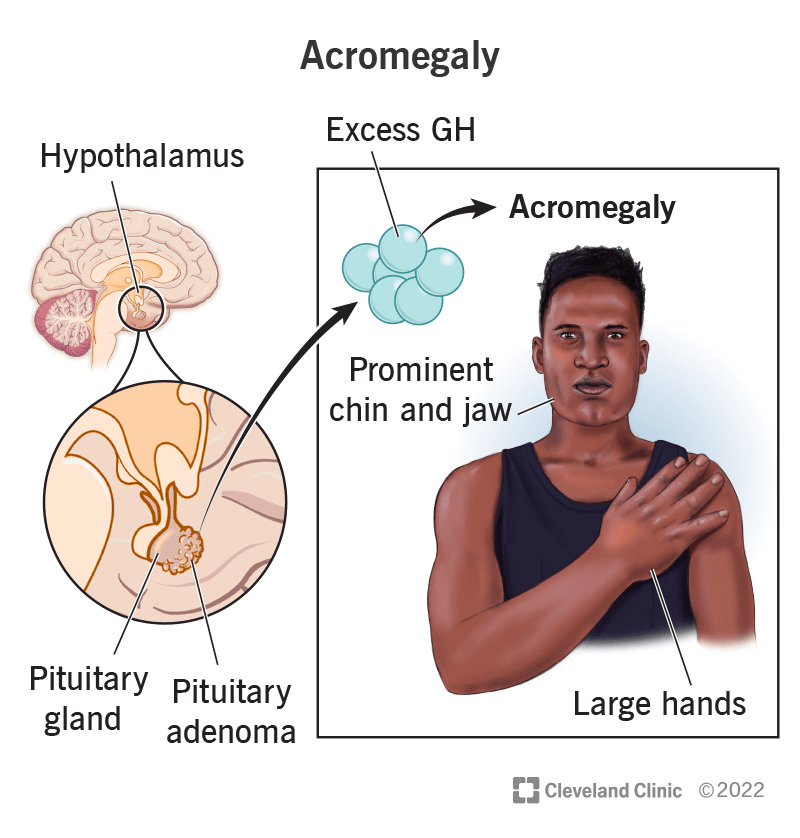
Acromegaly is an uncommon condition that develops slowly in adults when the pituitary gland makes too much growth hormone. This gland sits near the base of the skull and releases hormones that help manage many body functions. In most cases a noncancerous pituitary tumor is responsible for the excess hormone.
People with acromegaly often develop unusually large bones in their hands, arms, feet, legs and head. The jaws and the front part of the skull usually show the most noticeable changes. Soft tissues such as the heart, lips and tongue can also become thicker. If the condition is not treated it can lead to serious health problems and life threatening complications. When too much growth hormone is released before puberty the condition is called gigantism instead of acromegaly.
Symptoms:
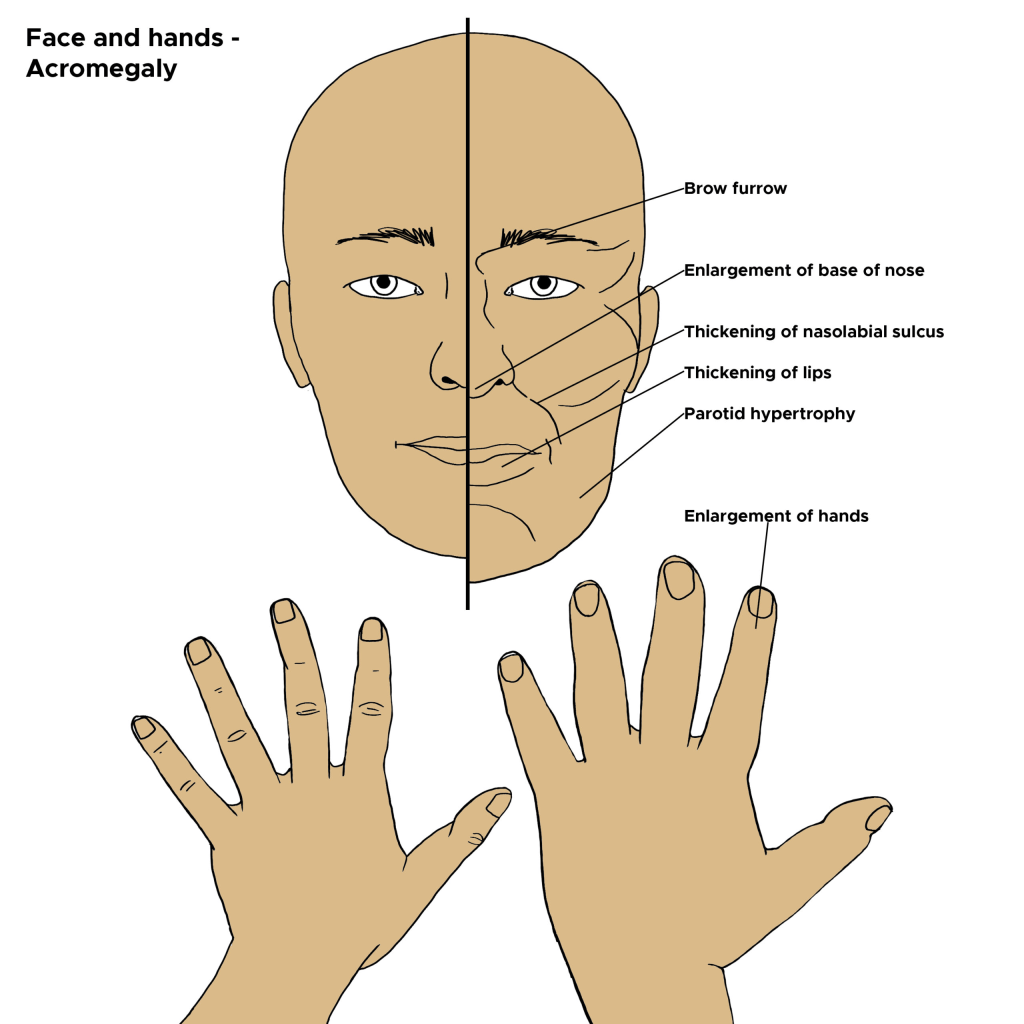
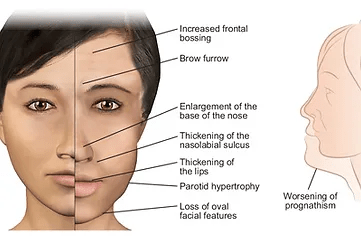
The symptoms of acromegaly usually appear slowly and become easier to notice as a person gets older. The signs can differ widely from one person to another because the condition can affect the body in many ways. The face gradually begins to look rougher because soft tissues and cartilage grow too much. The facial bones become more prominent, the lower jaw sticks out, and an underbite may form, which can cause the teeth to spread apart or become misaligned. Many people also develop a very large tongue and thick lips. The voice often becomes deep and rough because the vocal cords and sinuses grow larger.
The hands and feet slowly get bigger. Rings may feel tight or no longer fit and shoe size often increases. Extra bone growth and larger cartilage in the joints can lead to inflammation and the gradual wearing down of the joints. This often causes joint and muscle pain, especially in large joints like the knees, shoulders, hands, wrists and hips. Some people develop abnormal curves in the spine. Extra tissue can also press on nerves and cause numbness and weakness in the hands, which is known as carpal tunnel syndrome. The skin may become darker and thicker in certain areas. Some people grow more body hair and may develop skin tags.
Acromegaly can cause certain organs to grow larger than normal including the heart. This may lead to shortness of breath during activity and irregular heartbeats. Heart problems in acromegaly can eventually lead to heart failure, which causes fluid to build up in the heart, lungs and other tissues because the heart cannot pump blood properly. Other organs may also grow larger such as the liver, spleen, intestines, kidneys, thyroid and adrenal glands.
About one quarter of people with acromegaly have high blood pressure. Enlargement of the pituitary gland can cause headaches, vision problems and issues with hormone levels. About half of people with acromegaly develop problems related to insulin because too much growth hormone interferes with how insulin works. This can raise blood sugar levels and may lead to insulin resistance or type 2 diabetes. Some people also have a higher metabolic rate, heavy sweating and oily skin.
Breathing problems are common, especially sleep apnea. This condition causes repeated pauses in breathing during sleep. It can lead to waking up during the night, daytime tiredness, loud snoring and sometimes obesity. Obstructive sleep apnea happens when enlarged soft tissues block the airway. People may gasp for air and then resume breathing, but untreated sleep apnea can contribute to high blood pressure, irregular heartbeats, swelling of the limbs, hallucinations, anxiety and irritability.
Women with acromegaly may produce breast milk even when not pregnant and may have infrequent or delayed menstrual periods. Men may have trouble with sexual performance and reduced sexual desire. People with acromegaly are also more likely to develop colon polyps and have a slightly higher risk of colon cancer. In later stages of the condition, muscle weakness and nerve problems may appear. Vision may become impaired and can sometimes progress to blindness. Without treatment, about one quarter of people develop symptoms of uncontrolled diabetes such as sugar in the urine, extreme thirst and increased appetite.
Causes:
Acromegaly is a rare condition caused by having too much growth hormone in the body. In most people this happens because a noncancerous tumor grows in the pituitary gland. These tumors usually develop from somatotroph cells, which are the cells in the pituitary gland that normally make growth hormone. Growth hormone plays an important role in many body functions, including normal physical growth. One of its jobs is to trigger the body to make another hormone called insulin like growth factor one. Because of this, people with acromegaly also have high levels of insulin like growth factor one.
In rare cases acromegaly can occur because the hypothalamus, a part of the brain that controls hormone release, does not properly regulate the cells that produce growth hormone. Sometimes the hypothalamus or other tissues make too much growth hormone releasing hormone, which overstimulates the pituitary gland and causes excess growth hormone. On rare occasions tumors outside the pituitary gland, such as those in the pancreas, lungs or adrenal glands, may cause acromegaly. These tumors might make extra growth hormone themselves or they might produce growth hormone releasing hormone, which then prompts the pituitary gland to release too much growth hormone.
Some people develop acromegaly as part of certain genetic conditions such as multiple endocrine neoplasia type one, familial isolated pituitary adenoma, Carney complex and McCune Albright syndrome. X linked acrogigantism leads to gigantism and is caused by the duplication of small segments on the X chromosome. For most people, however, acromegaly develops randomly and is not caused by an inherited genetic change.
Diagnosis:
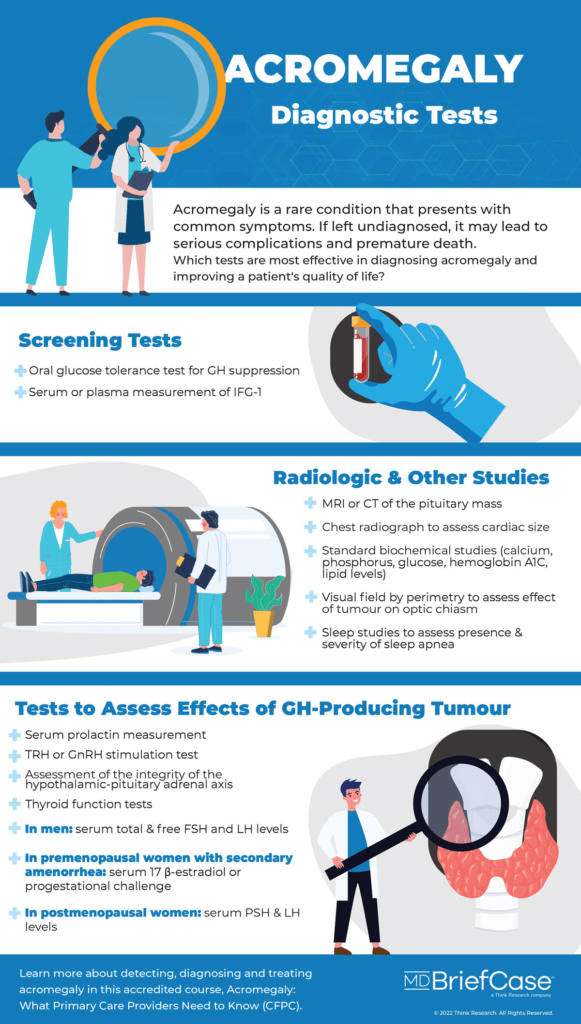
Diagnosing acromegaly can be challenging because the symptoms develop slowly over many years. Doctors make the diagnosis by reviewing a person’s medical history, performing a physical exam, looking for typical signs of the condition and ordering specific tests. These tests may include blood tests, a glucose tolerance test and imaging studies such as an MRI or CT scan.
Blood tests can check for high levels of growth hormone or insulin growth factor one. Measuring insulin growth factor one is the most reliable blood test for screening. Growth hormone levels are often checked along with a glucose tolerance test. In this test a person drinks a set amount of sugar that should normally cause growth hormone levels to drop. In people with acromegaly this drop does not happen.
An MRI or CT scan of the brain may be used to look for a pituitary tumor and to determine its size. An MRI uses a magnetic field and radio waves to create detailed images of the inside of the body. A CT scan uses a computer and X rays to take cross sectional images of tissues and organs.
Other tests may be done to see how far the condition has progressed. These may include an echocardiogram to check the heart, tests for sleep apnea and a colonoscopy to examine the colon and provide a baseline for future screening. Because people with acromegaly are at higher risk for bone fractures they may also have X rays or a bone density test called a DXA scan.
Treatment:

Treatment for acromegaly focuses on the symptoms each person has. Care often involves several types of medical specialists. The main goals are to bring growth hormone levels back to normal, shrink any pituitary tumor to reduce pressure on nearby brain tissue, keep the rest of the pituitary working normally, and improve related symptoms.
Most people are treated with surgery, medicine, radiation, or a combination. No single approach works for everyone. The treatment plan depends on factors such as the size and location of the pituitary tumor, a person’s symptoms, age, overall health, and preferences. Doctors and patients should discuss benefits, risks, side effects, and long term effects before deciding on a plan.
The most common treatment is transsphenoidal surgery in which a surgeon removes all or part of the pituitary tumor. This often relieves pressure quickly and lowers growth hormone levels. People with small tumors usually respond better than those with larger tumors. Surgery may not fix every symptom and sometimes the entire tumor cannot be removed which leaves hormone levels too high. Regular follow up is needed because the condition can return. Some people need additional treatment if surgery does not completely correct hormone levels.
Medicine can be used when surgery is not possible, does not work well, does not fully correct hormone levels, or does not shrink a large tumor enough before surgery. There are three main types of medication used for acromegaly. The first type includes somatostatin receptor drugs such as octreotide, lanreotide, and pasireotide. The second type blocks growth hormone with a drug called pegvisomant. The third type includes dopamine agonists such as bromocriptine and cabergoline although these help fewer patients and are often used with other treatments.
Octreotide, lanreotide, oral octreotide, and pasireotide are approved medicines that lower growth hormone and IGF I levels and can shrink tumors in some people. These drugs act like the natural hormone somatostatin which helps control growth hormone release. Pegvisomant blocks the action of growth hormone and is given by injection. Paltusotine is an oral medicine taken once daily for people who cannot have surgery or whose surgery did not fully work.
Radiation therapy may be added when surgery and medicine do not lower tumor size or hormone levels enough. Standard radiation therapy is usually given daily for several weeks and may take years to show full results. Because of the delay it is rarely used alone. Some people may receive newer forms of targeted radiation which deliver strong focused beams in one session. These treatments reduce damage to nearby tissue but are only possible when the tumor is far enough from the optic nerves. More research is needed to understand their long term safety and effectiveness.
People with acromegaly need regular medical checkups to ensure the pituitary works normally and to confirm that symptoms continue to improve. Medication doses may need adjustment over time to keep hormone levels controlled.
How You Can Make an Impact:
Without proper research, funding, and support for continued studies and clinical trials to determine possible cures, legitimate medicines for the disease, or preventative treatment, many more children will go on to develop Acromegaly. If you can, please donate here! If you are unable to donate, consider volunteering your time by raising awareness for this rare disease. If you’re interested in learning more about Acromegaly, donation opportunities, or the progress being made on potential treatments, visit the Acromegaly Community. The Acromegaly Community strives “to provide an emotional and communal support network for people touched by Acromegaly. We offer a central location for medical information on issues including: surgery, medication, radiation, and post diagnosis support. Most importantly, we work to provide a network of emotional support for our Acromegaly patients, their friends and their family.”
References:
Carmichael, J. D. (2025, October 6). Acromegaly – Symptoms, Causes, Treatment | NORD. NORD (National Organization for Rare Disorders). https://rarediseases.org/rare-diseases/acromegaly/
 Rare Disease Insights
Leave a comment