What is AKU?:
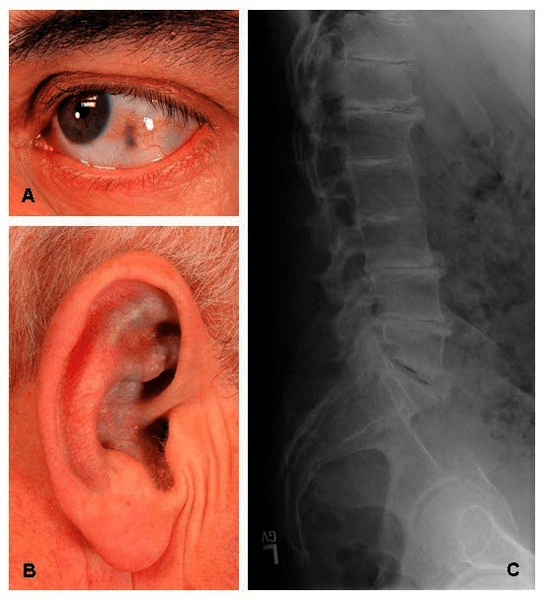
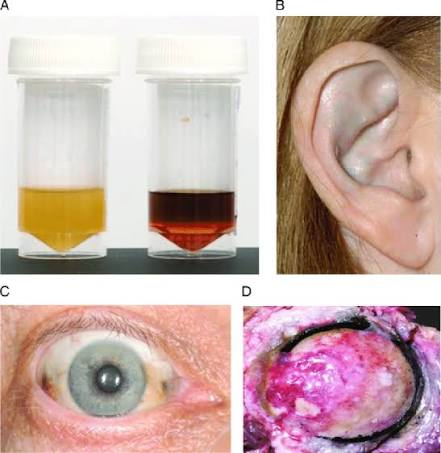
Alkaptonuria is a rare genetic metabolic disorder caused by mutations in the HGD gene, which leaves the body lacking the enzyme needed to break down homogentisic acid. This causes the acid to build up over time, with the earliest sign often being urine that turns black or dark when exposed to air, though this change frequently goes unnoticed in infancy and childhood. Because affected individuals are otherwise asymptomatic early in life, they usually remain unaware of their condition until adulthood. Over time, the continuous accumulation leads to ochronosis along with progressive, painful arthritis in the spine and large joints.
Symptoms:
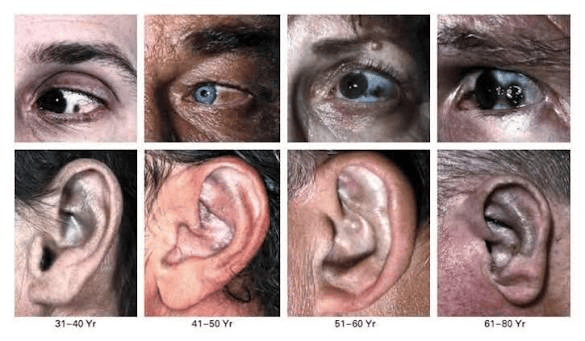
Alkaptonuria is a progressive genetic disorder characterized by the lifetime buildup of homogentisic acid, which first manifests in infancy as urine that turns black upon air exposure, though this early sign is often missed. Symptoms rarely emerge until around age 30, driven by the chronic accumulation of the acid in cartilage and connective tissues. This results in ochronosis, while making tendons and ligaments weak, brittle, and prone to rupturing. The most severe impact is a debilitating form of arthritis that targets the spine and large joints, causing flattened discs, spinal hunching, joint fluid buildup, and potentially joint fusion, often necessitating joint replacements earlier in men than women. Additionally, the disorder frequently leads to painful kidney and prostate stones, as well as cardiovascular complications like the thickening, calcification, and narrowing of the aortic and mitral heart valves. While alkaptonuria causes significant chronic pain and mobility issues, it does not cause cognitive impairment or shorten a person’s lifespan.
Causes:
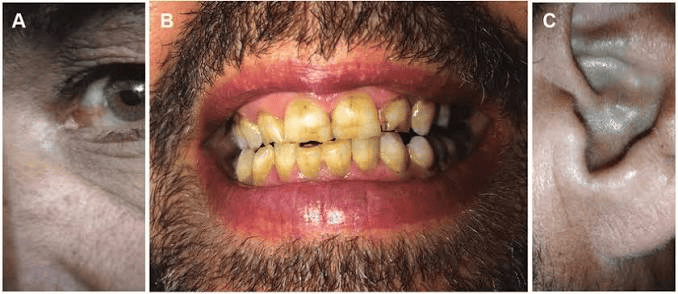
Alkaptonuria is an autosomal recessive genetic disorder caused by mutations in the HGD gene, which normally provides instructions for creating the enzyme needed to break down homogentisic acid. Because of this mutation, the body lacks functional levels of the enzyme, causing the acid to slowly and continuously accumulate in connective tissues like cartilage. Though the kidneys actively filter it out, the decades-long buildup eventually turns tissues a slate blue or black, weakening and damaging them by adulthood to produce the condition’s signature symptoms. For a child to inherit alkaptonuria, both parents must be carriers of the abnormal gene; with each pregnancy, there is a 25% chance the child will inherit two mutated genes and develop the condition, a 50% chance they will be an asymptomatic carrier, and a 25% chance they will be genetically unaffected, with risks being identical for both males and females.
Diagnosis:
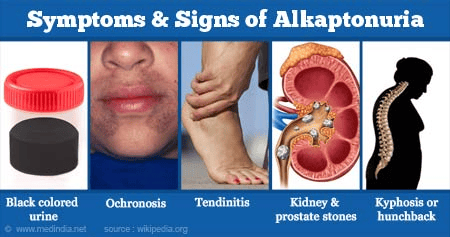
The diagnosis of alkaptonuria relies on evaluating a patient’s symptoms and medical history alongside specialized tests, with the definitive indicator being vastly elevated levels of homogentisic acid detected in the urine via gas chromatography-mass spectrometry analysis. Because dark urine is not universally present, it is recommended to screen patients with early-onset osteoarthritis to rule out the condition. While molecular genetic testing can identify mutations in the HGD gene, it is not strictly required to confirm a diagnosis. To assess the internal progression of the disease, various imaging techniques are used to evaluate spinal and joint damage, while individuals over 40 may undergo echocardiography to check for heart valve thickening, calcification, or backflow, as well as computed tomography scans to detect potential coronary artery calcification.
Treatment:
Managing alkaptonuria focuses on symptom-specific care and long-term pain management, which typically involves tailored regimens of anti-inflammatories or stronger narcotics alongside physical and occupational therapy to preserve joint flexibility. Because dietary restrictions and high-dose vitamin C have generally proven ineffective and difficult to maintain long-term, patients are instead advised to avoid high-impact sports and heavy manual labor to protect vulnerable tissues. Genetic counseling is highly recommended for families, and as the disease advances, surgical intervention becomes common; roughly half of all patients require a major joint replacement by age 50 or 60, while others may eventually need spinal surgery, heart valve replacements, or procedures to treat painful kidney and prostate stones.
How You Can Make an Impact:
Without proper research, funding, and support for continued studies and clinical trials to determine possible cures, legitimate medicines for the disease, or preventative treatment, many more people will go on to develop Alkaptonuria. If you can, please donate here! If you are unable to donate, consider volunteering your time to raise awareness about this rare disease. If you’re interested in learning more about AKU, donation opportunities, or the progress being made on potential treatments, visit the AKU Society of North America.
References:
Introne, W. (2015). Alkaptonuria – NORD (National Organization for Rare Disorders). NORD (National Organization for Rare Disorders); NORD. https://rarediseases.org/rare-diseases/alkaptonuria/
 Rare Disease Insights
Leave a comment